Lisson at Frieze Seoul 2026
28 July 2026
Lisson is pleased to return to Frieze Seoul with a presentation of new and historic works spanning painting, sculpture, textiles, and photography. The booth brings together works by Olga de Amaral, Huguette Caland, Ryan Gander, Hugh Hayden, Leiko Ikemura, Anish Kapoor, Julian Opie, Dalton Paula, and Hiroshi Sugimoto, among others.
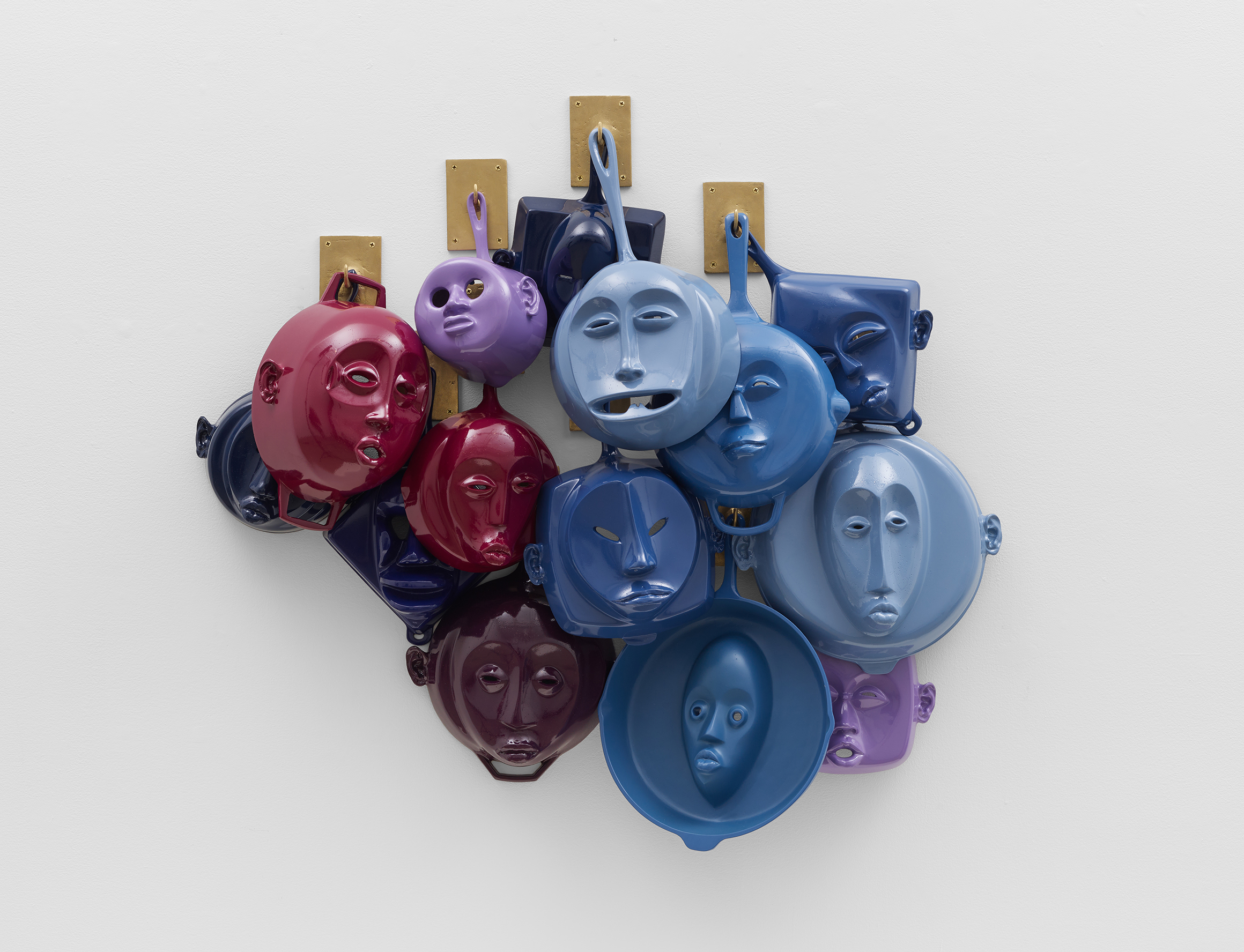
A central highlight on the booth is Hugh Hayden’s The blacker the berry the sweeter the juice (2026), a new work that is part of a continued series of skillet works that transform familiar objects through selection and carving to challenge our perceptions of ourselves, others, and the environment. Their specialized forms and polished surfaces suggest both individuality, purpose and collectivity.
Nearby, Anish Kapoor’s Tangerine over Red and Spanish and Pagan Gold (2020) a concave mirror which teases and tests the boundaries of spatial perception. The curved, aluminum plate projects a focused image between the viewer and work. From a distance, the reflected image within the lacquered surface appears upside down alluding to the possibility of an alternate perceptual reality. The presentation coincides with major solo exhibitions by the artist at Palazzo Manfrin in Venice, the Hayward Gallery in London and The Serlachius Museum in Finland.
Ahead of his solo exhibition at Lisson New York this September, Hiroshi Sugimoto’s Brush Impression 1617 (River) (2024) features large-scale calligraphic strokes meticulously developed using photographic methods akin to Sugimoto’s traditional process. Alongside this, Sugimoto presents Opticks 616 (2023) from his series of large-scale photographic prints which rely on a prism to split ‘white’ light into its seven constituent colours and many more gradations and shades in between.
Following Lisson New York’s first solo exhibition of Huguette Caland’s work, the artist’s Untitled (Self Portrait) (1980) is featured on the booth. The subject faces the viewer directly, as in the style of European portraiture, in one of her signature kaftans. As in many of the artist’s self-portraits, the eyes are missing, so viewers are instead greeted with her open visage.
A textile work by Olga de Amaral, Nébula 16 (2016), demonstrates the artist's ongoing fascination with the interrelationships between geometric abstraction, design and traditional craft. The title (meaning ‘cloud’ or ‘fog’ in Latin) refers to the cosmological phenomenon of clouds of dust or gas in interstellar space creating brightly colored luminescent formations and points to the numinous or spiritual dimensions of art as one of the central preoccupations of Amaral’s practice.
Pedro Reyes presents stone mosaics on the booth. Intricately composed of tesserae made from volcanic stone, marble, glass, silver and gold, the works radiate with vibrant colour and material richness. They draw heightened attention to pattern, detail and material intimacy while maintaining the conceptual depth that defines Reyes's practice. Leiko Ikemura’s sculptural work Miko (2008/2024) further grounds the presentation. The feline-esque statue exists between genders and species, sculpted through the primordial energy of the earth. Ikemura’s spiritual works are imbued with a raw and tender presence that highlights the intimate relationship between human, animal, plant, mineral forms, and cosmology.
An additional highlight includes Julian Opie’s Year 4 A. (Third Grade A) (2025). United by the theme of the walking figure, this work comprises four children frozen mid-stride. Opie has mixed and matched the figures to create a “balance and dynamism” reminiscent of figures on an ancient Egyptian wall fresco or athletes on a Greek vase. Ryan Gander presents The thermals made me lazy, or The squatters (Smoky meet Monk’s Deflated Sculpture II (2009)) (2020), a hyperreal, animatronic cat. The cat is purportedly a stray, sleeping peacefully in the vicinity of a white plinth with its distinct sleeping posture, eerily still, except for gentle breathing. With this, Gander continues to explore the social, political and philosophical questions that are brought to bear in considering the complex relations between humans, animals, and machines.
Elsewhere on the booth, Dalton Paula’s Baba Egun (2025) features portraits of children and toys, while continuing his sustained commitment to recovering Afro-Brazilian histories through image-memories—narratives that resist colonial erasure and center Black resilience. While the scenes of birthdays, games, offerings, and everyday intimacy may appear novel within Paula’s visual language, they continue a longstanding thread in his practice.
Image: Hugh Hayden, The blacker the berry the sweeter the juice, 2026, Powder-coated aluminum skillets, 121.9 x 132.1 x 30.5 cm, 48 x 52 x 12 in © Hugh Hayden, Courtesy Lisson